UEA ENV Climatic Research Unit Climate Data


UEA and CRU logo

GLOBAL TEMPERATURE 2025


You are free to use, share, publish and adapt these images (see license at the bottom)

The 2025 data values mentioned in the text and shown in the graphs/maps are still preliminary and subject to minor changes. Finalised data will be provided on 14 January.

Media enquiries and interview requests can be directed to the UEA media centre.


Climatic Research Unit 2025 global temperature report

Click each heading to expand a section.


Global temperature change 1850 to 2025: HadCRUT5

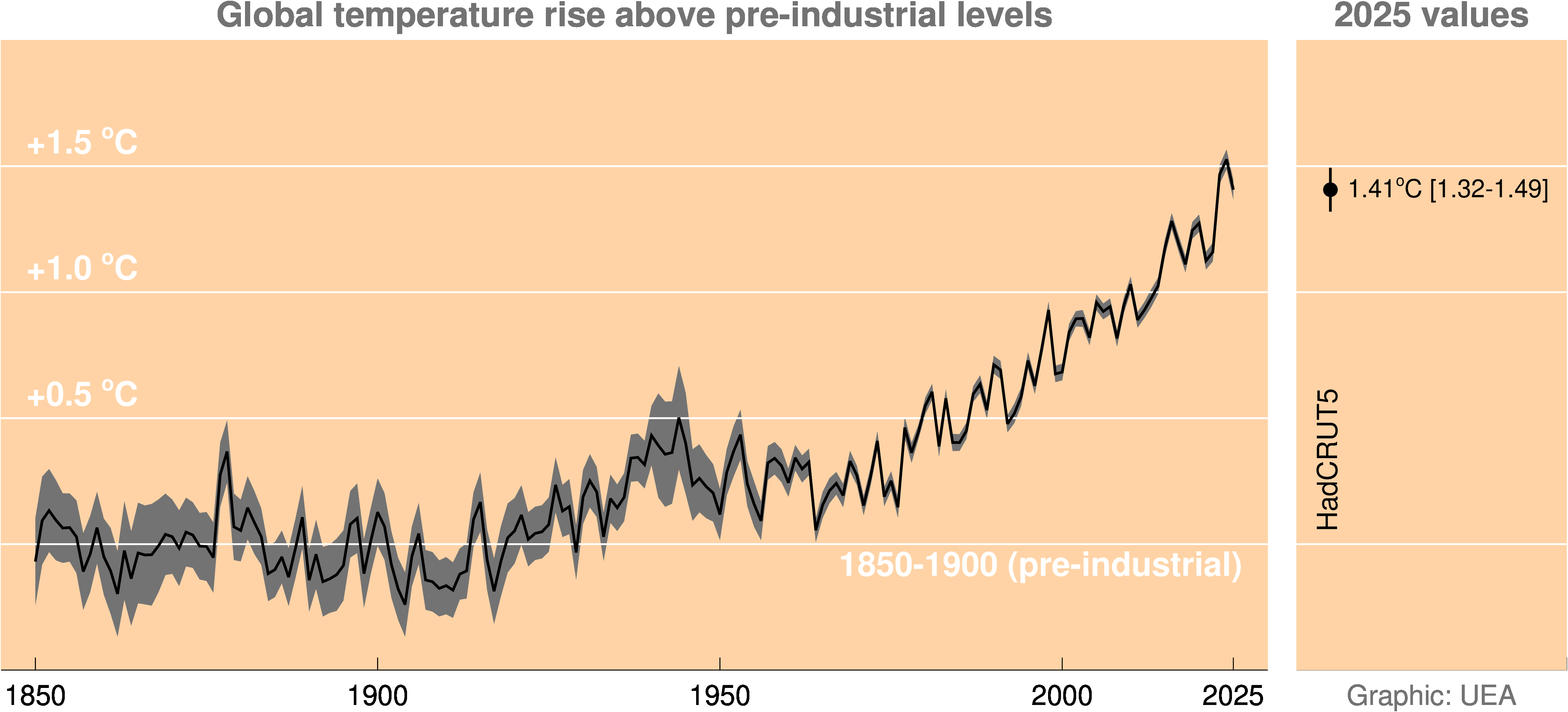
  • 2025 was the third warmest year on record globally (after 2024 and 2023) at 1.41°C above pre-industrial levels according to the global temperature estimated jointly by UK scientists at the Met Office, the University of East Anglia (UEA) and the National Centre for Atmospheric Science (NCAS).
  • The HadCRUT5 dataset shows 2025 was 1.41 (uncertainty range 1.32 to 1.49) °C above the 1850 to 1900 baseline, commonly used as the pre-industrial level
  • Our global temperature observations show that the world is continuing to warm in line with predictions made by climate scientists worldwide.
  • A natural climate variation in the Pacific Ocean, known as the El Niño-Southern Oscillation, temporarily added about 0.1°C to the global temperature in 2023 and 2024, contributing to the abrupt onset of the recent temperature surge. This natural influence weakened by 2025 and therefore the global temperature we observed in 2025 provides a clearer picture of the underlying warming (i.e. about 1.4°C above pre-industrial levels, but with an uncertainty of about 0.1°C arising mostly from uncertainty in the nineteenth century data).

Annual

Click image for a larger version


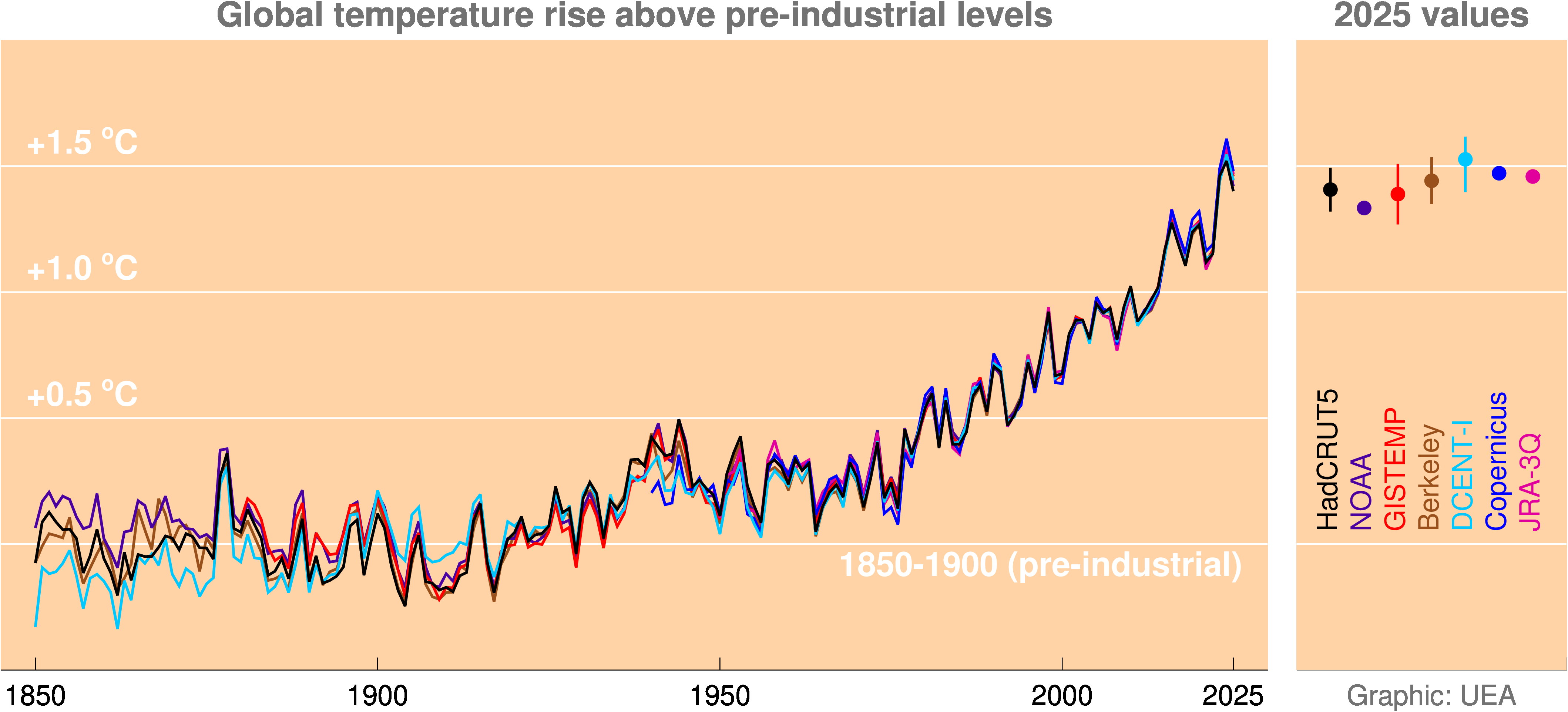
Global temperature change 1850 to 2025: multiple datasets

  • Different groups use different ways to estimate global temperature change from millions of individual temperature observations, yet they all agree that 2023, 2024 and 2025 were the warmest three years on record. This illustrates how science is done, trying different approaches to check that the results are not sensitive to particular methods.
  • In all seven datasets, 2024 was clearly the warmest year globally. Global temperatures in 2023 and 2025 were quite similar, with 2025 third warmest in five of datasets and second warmest in two.
  • The seven different teams estimate that 2025 was between 1.33 and 1.53°C above pre-industrial, confirming that the UK team's value of 1.41°C [uncertainty range 1.32 to 1.49] is robust.

Annual (using publicly available data released on 14 January 2026)

Data available here: csv and xslx formats

Note: in the left panel of this graph, the individual series have been offset so that they all have the same mean during 1981-2010 and the average of the HadCRUT5, NOAA, Berkeley and DCENT-I 1850-1900 baselines is also zero. Each individual series' pre-industrial baseline is then no longer zero, but it illustrates that the overall uncertainty (indicated by the spread between datasets) is greatest pre-1950, and especially pre-1900, and there is very strong agreement between datasets in the last 50 years.

Click image for a larger version
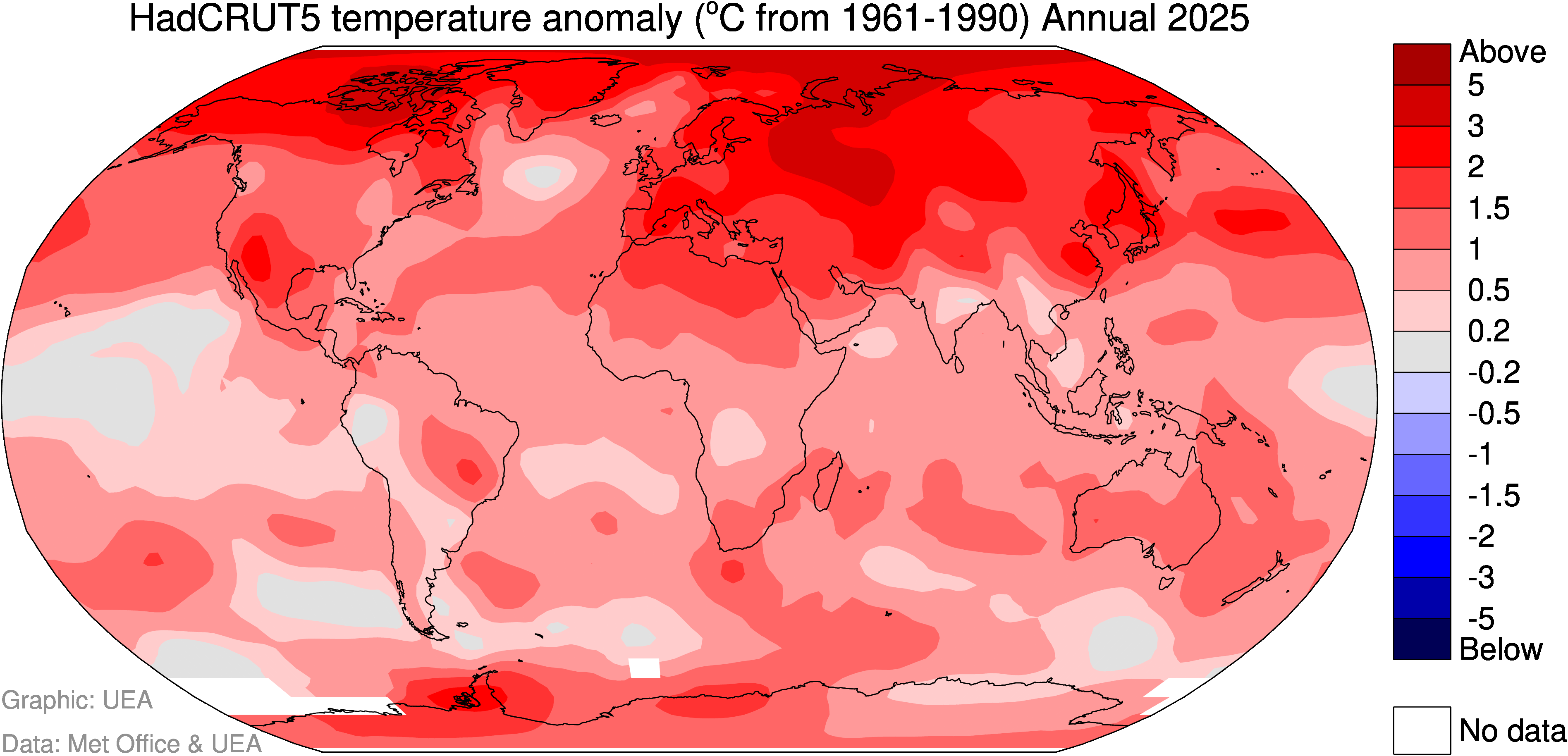


Where were the warmest temperature anomalies in 2025?

Annual

Click image for a larger version


Annual average 2025 temperatures were warmest on record across parts of the North Pacific Ocean, in western Antarctica, western Russia and parts of the North Atlantic close to the UK and Ireland.
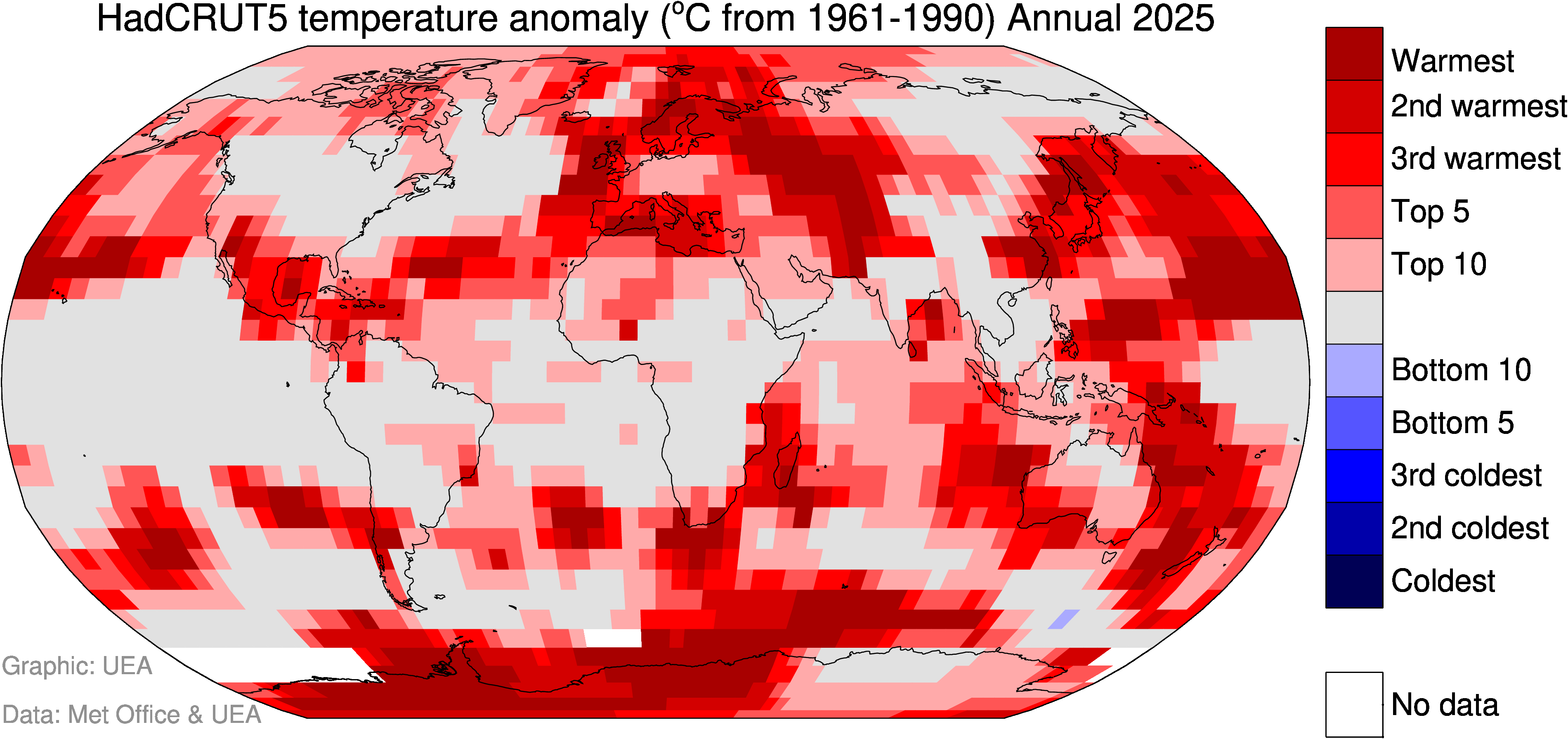


Where were record warm temperatures observed in 2025?

Map shows where 2025 average temperatures were the warmest recorded, or second warmest, etc.

Click image for a larger version


Click play below to view the animation
  • No, the Paris 1.5°C goal has not yet been exceeded
  • The Paris Climate Agreement aims to hold the increase in global temperature to well below 2°C above pre-industrial levels and to try to keep it closer to 1.5°C
  • However these goals are commonly interpreted to refer to the underlying warming averaged over more than a decade rather than to individual years
  • The video below illustrates how the underlying average warming is still below 1.5°C even though our data show that the individual year 2025 was likely more than 1.5°C above pre-industrial


Click play to watch the animation

Click here if the video doesn't play in your browser
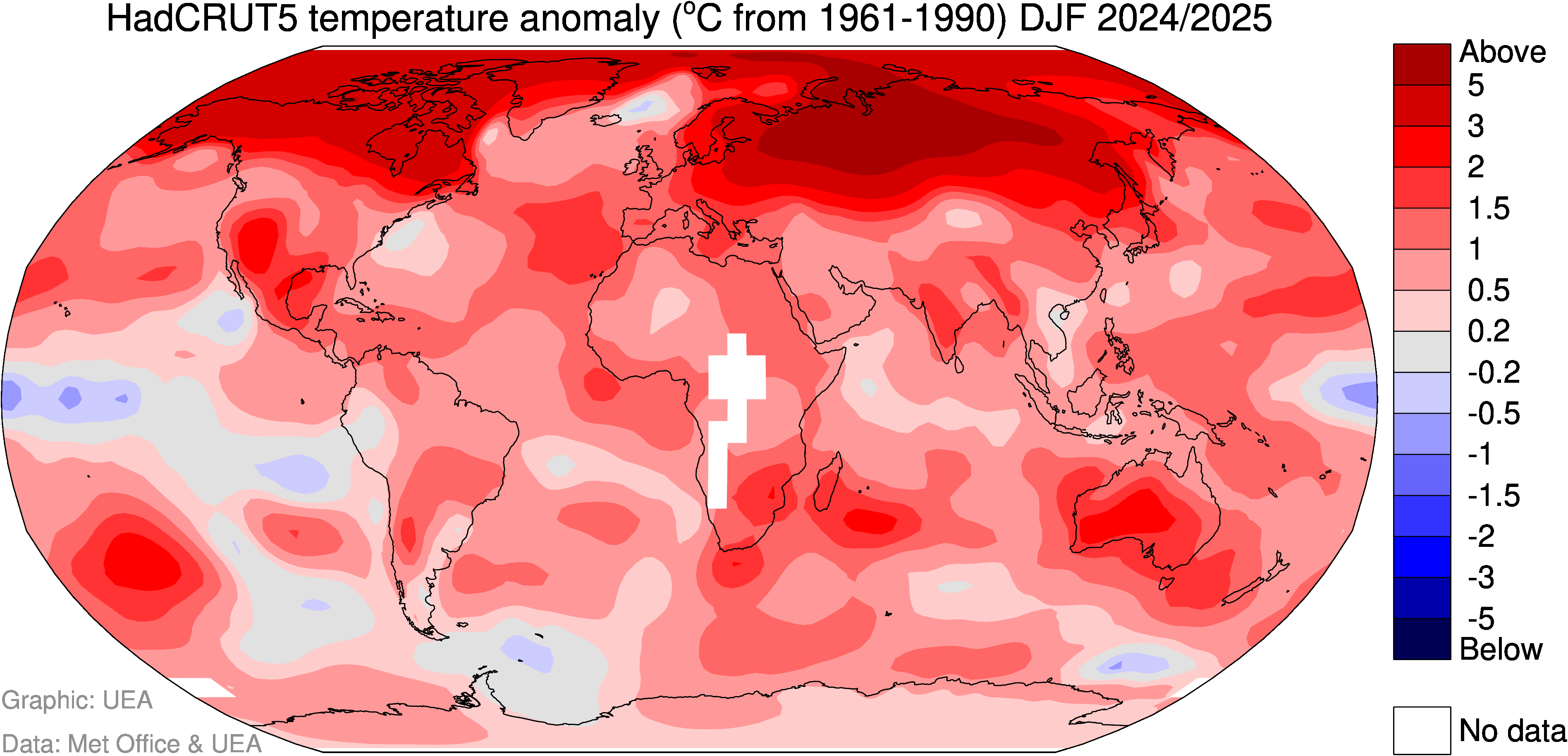


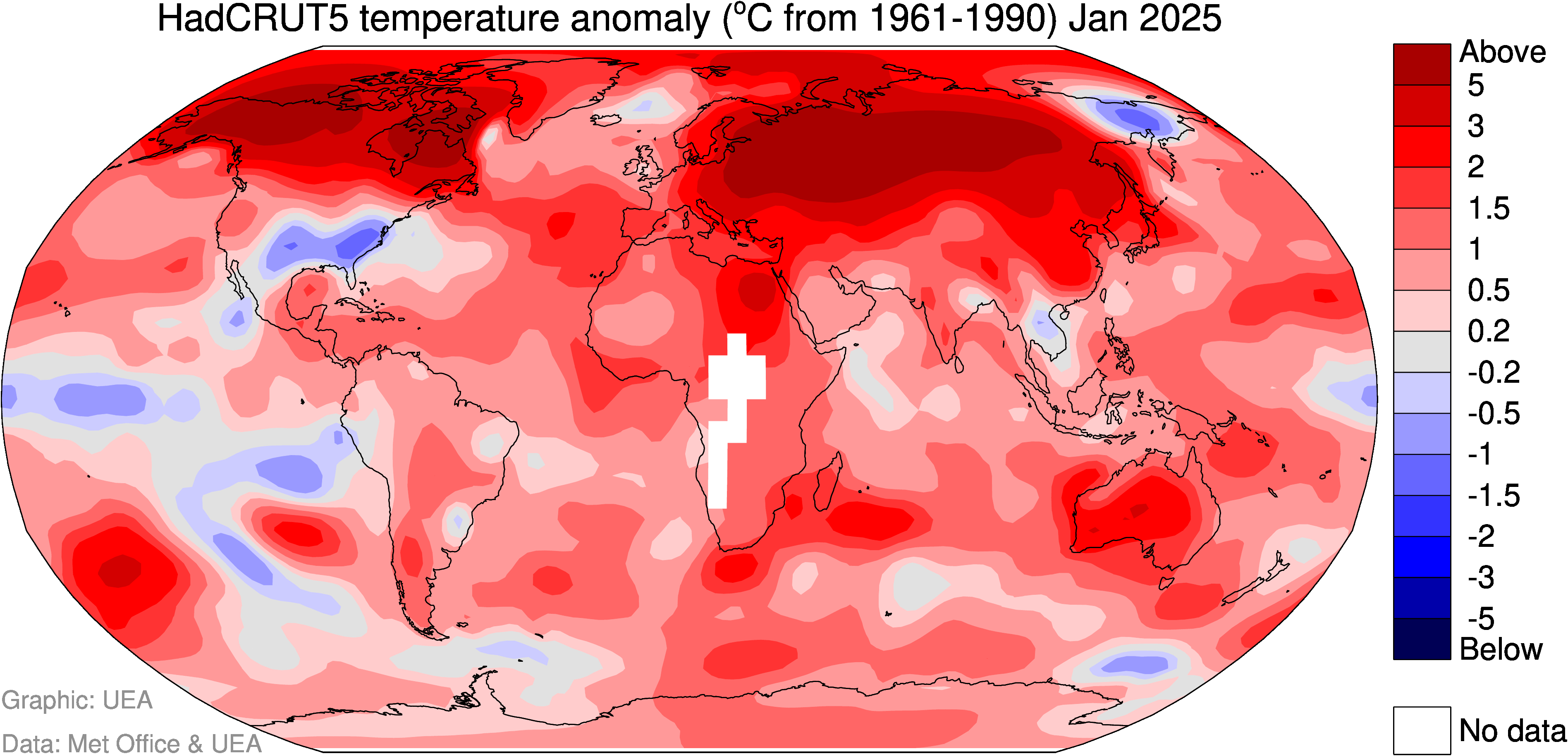
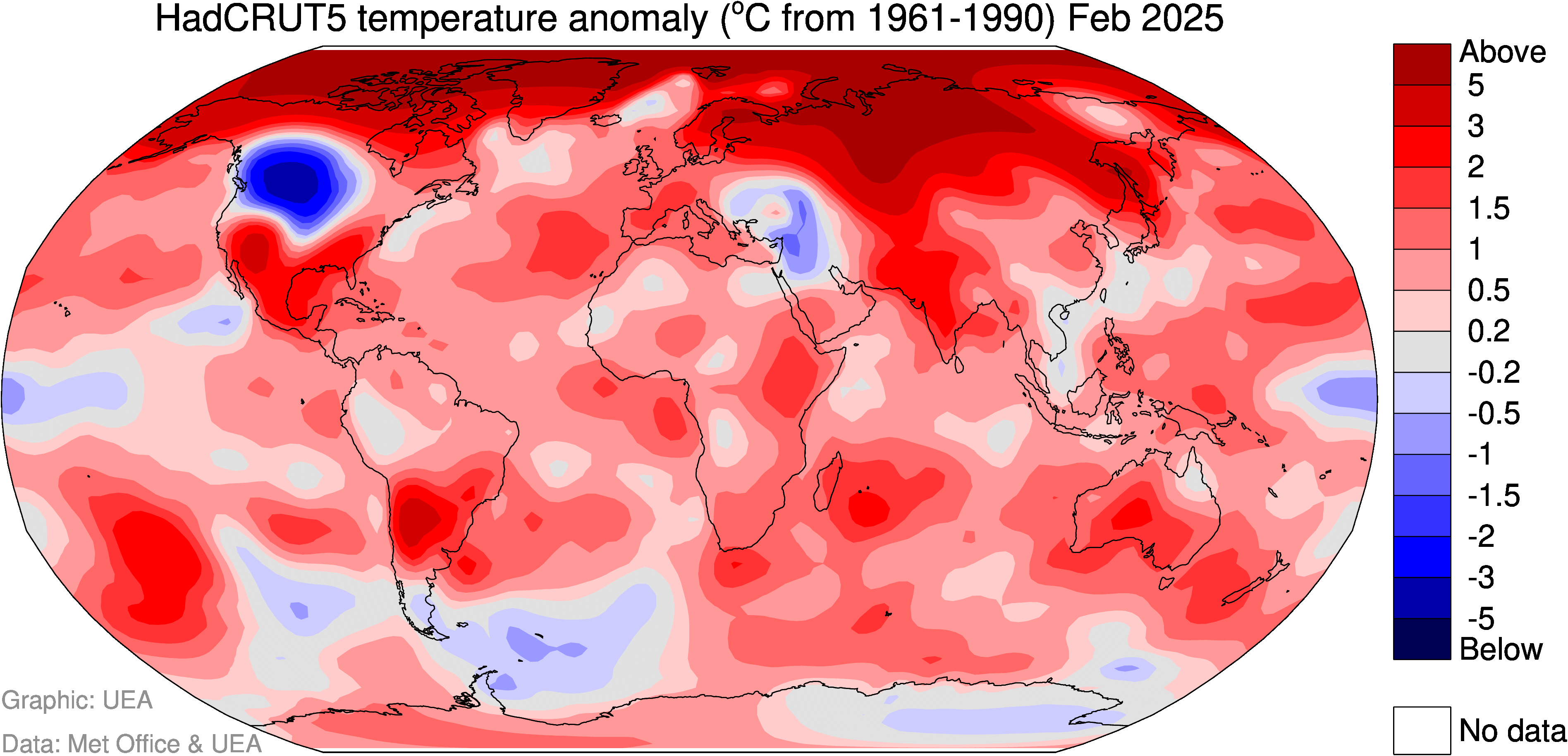
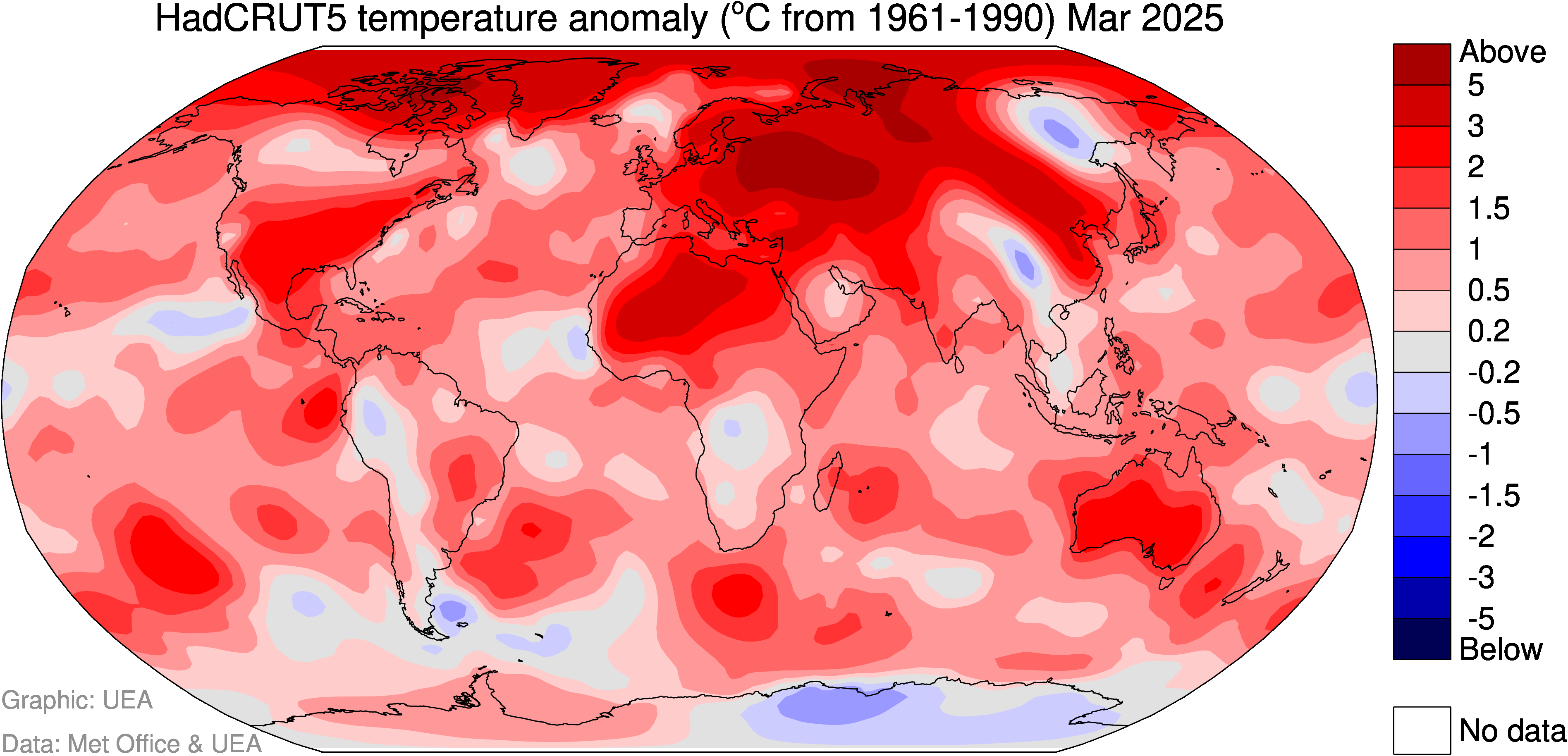
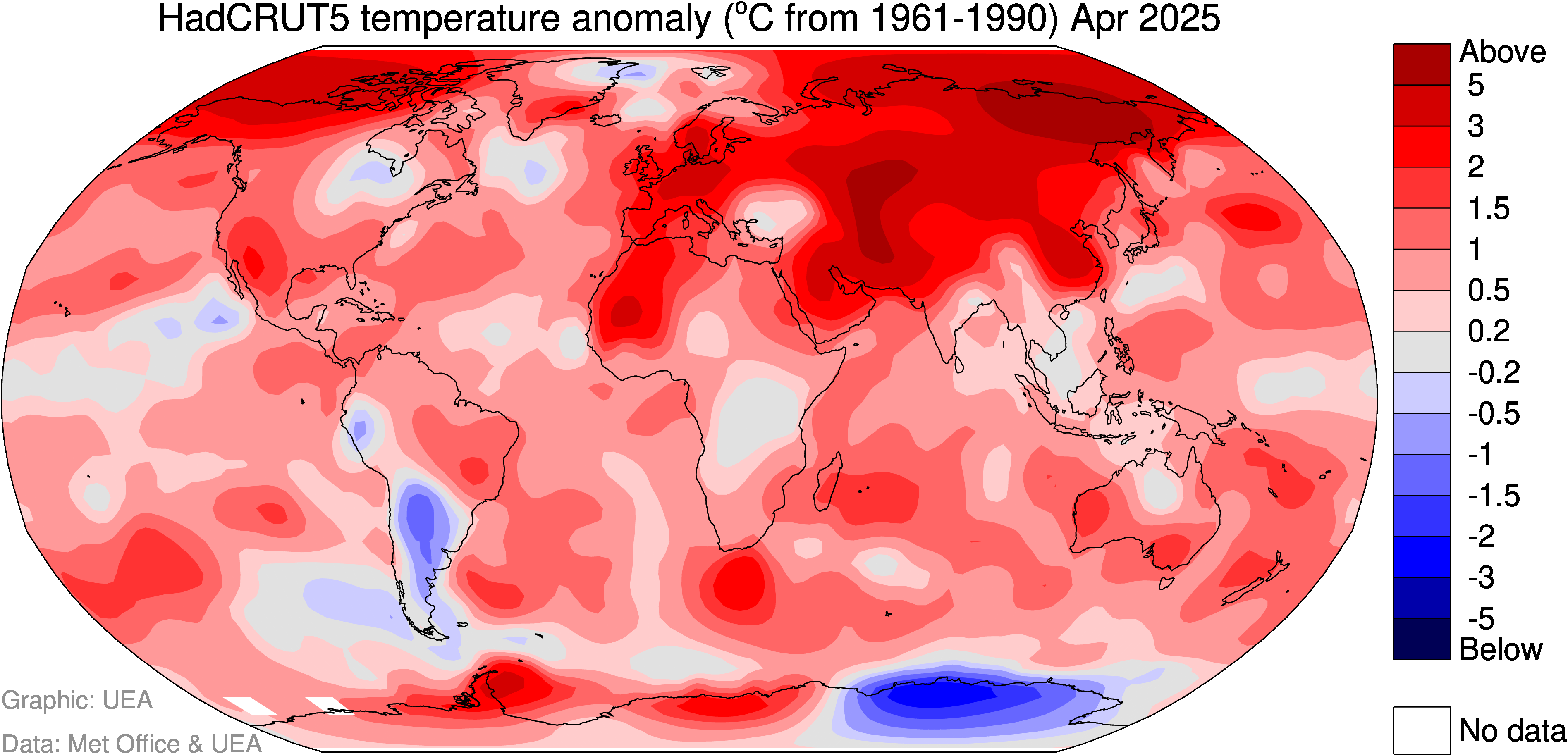
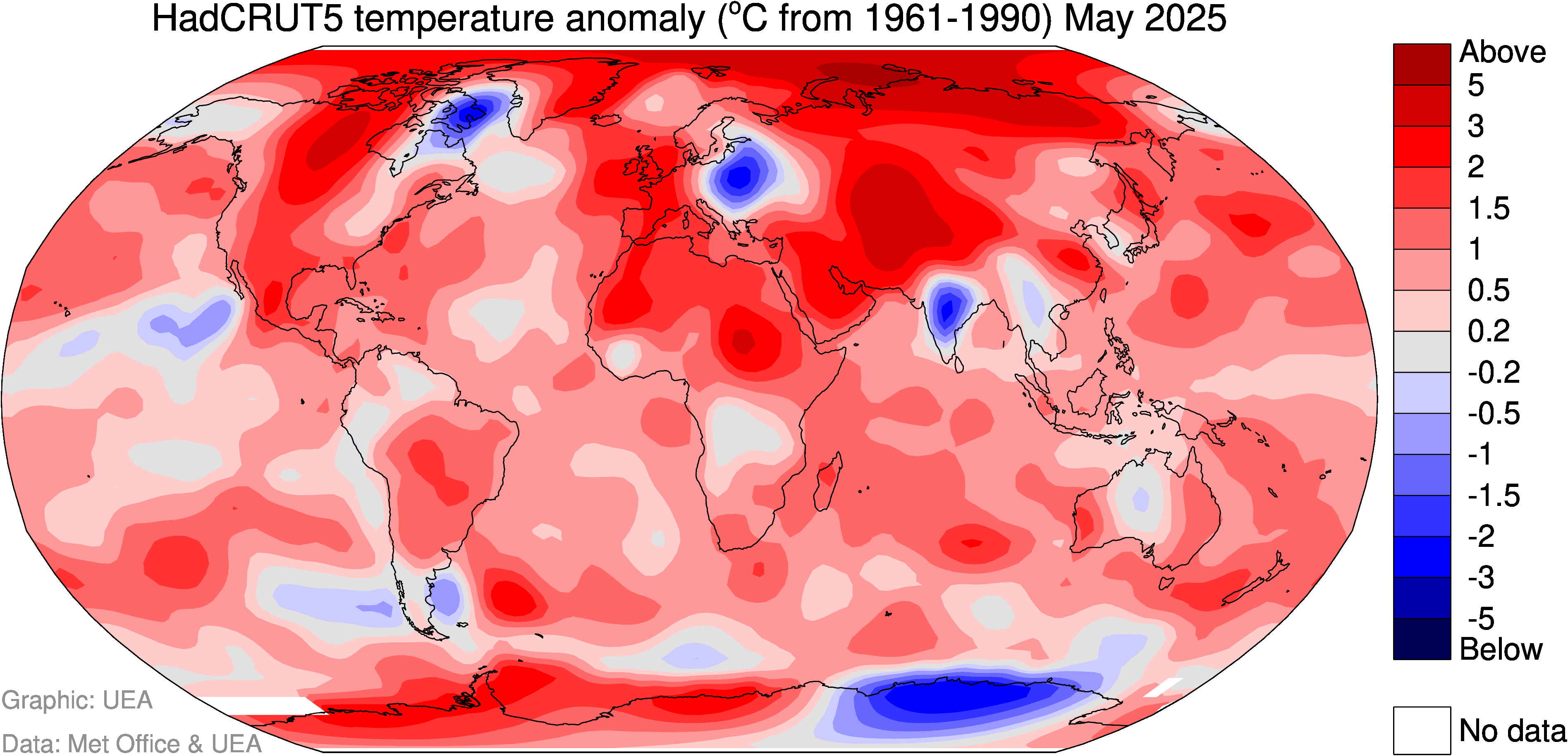
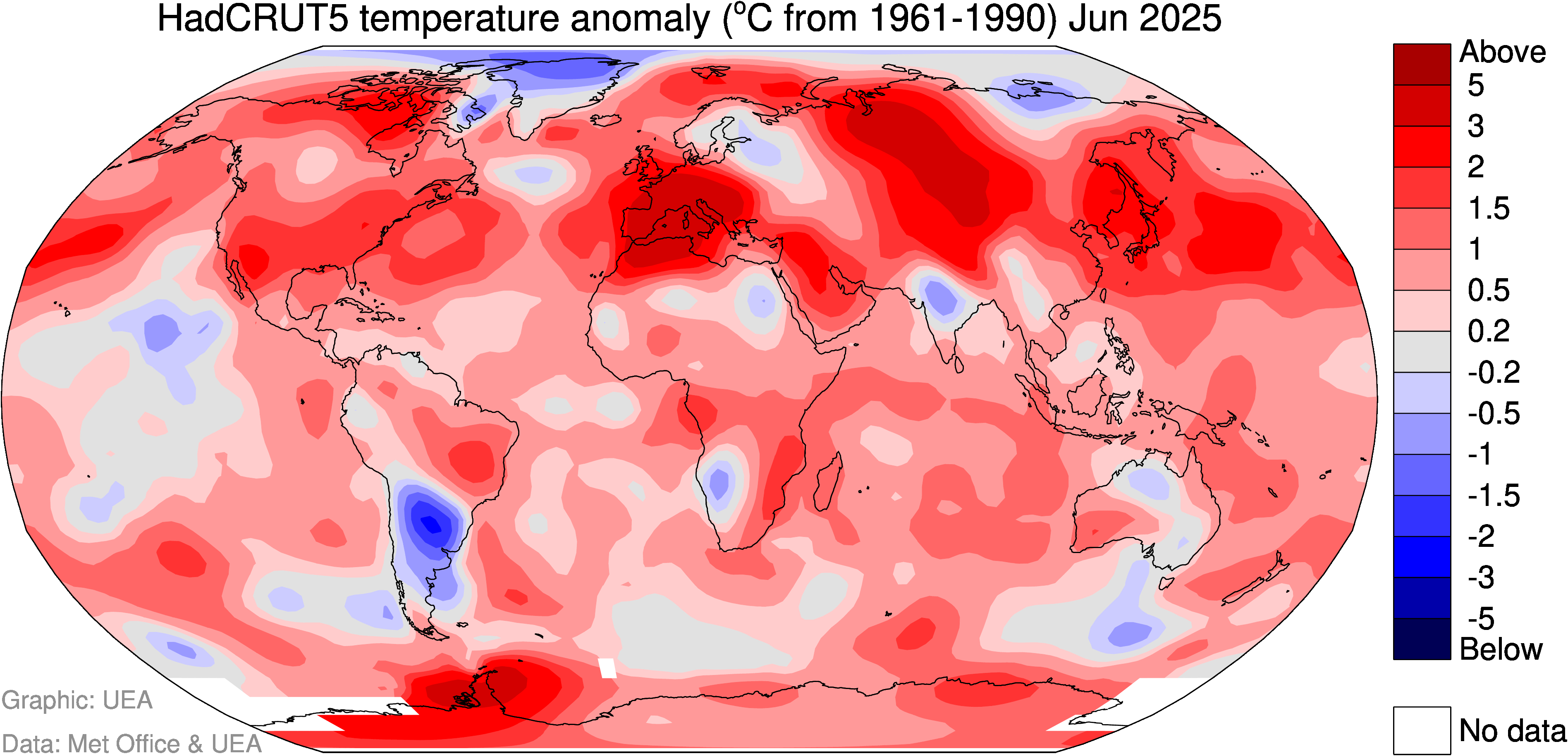
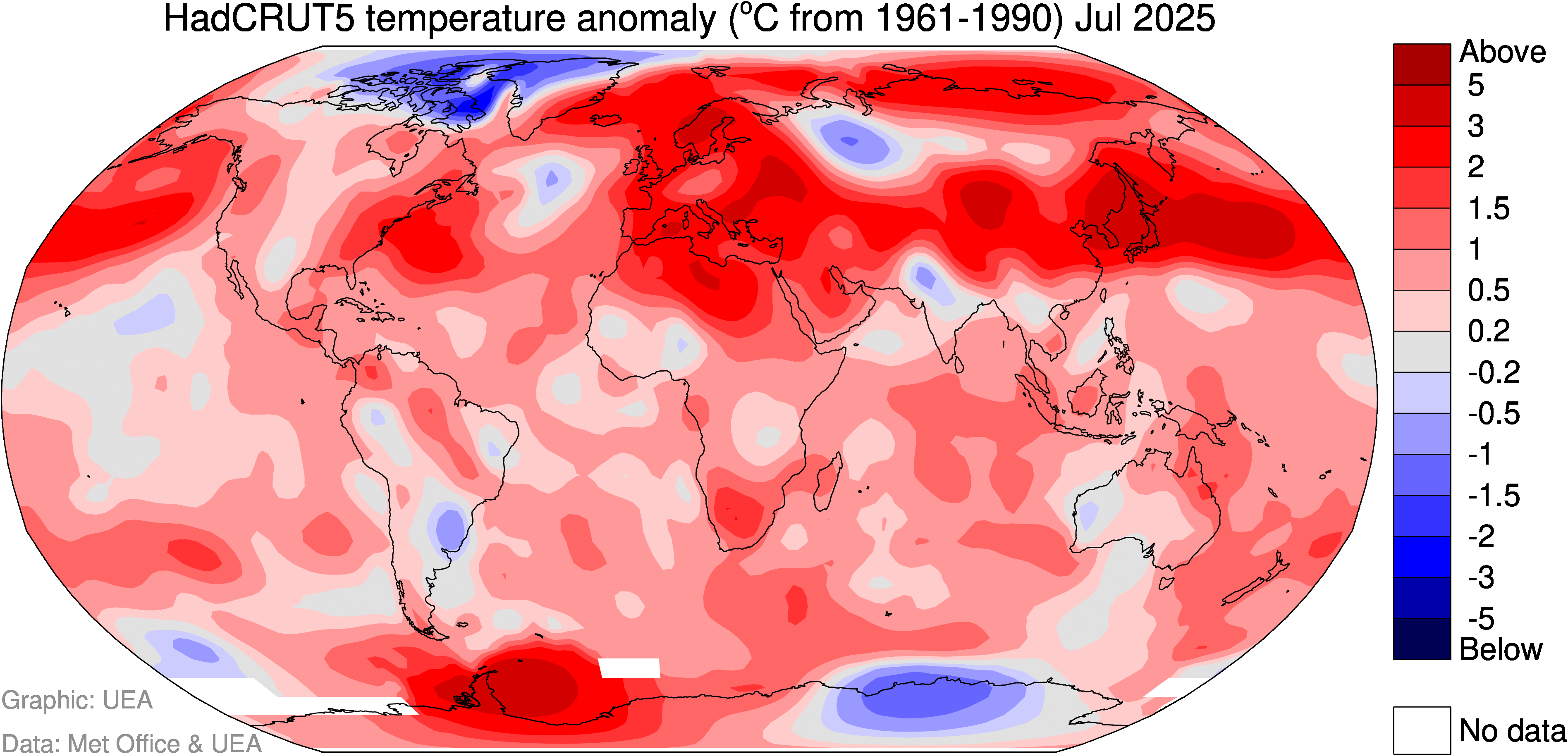
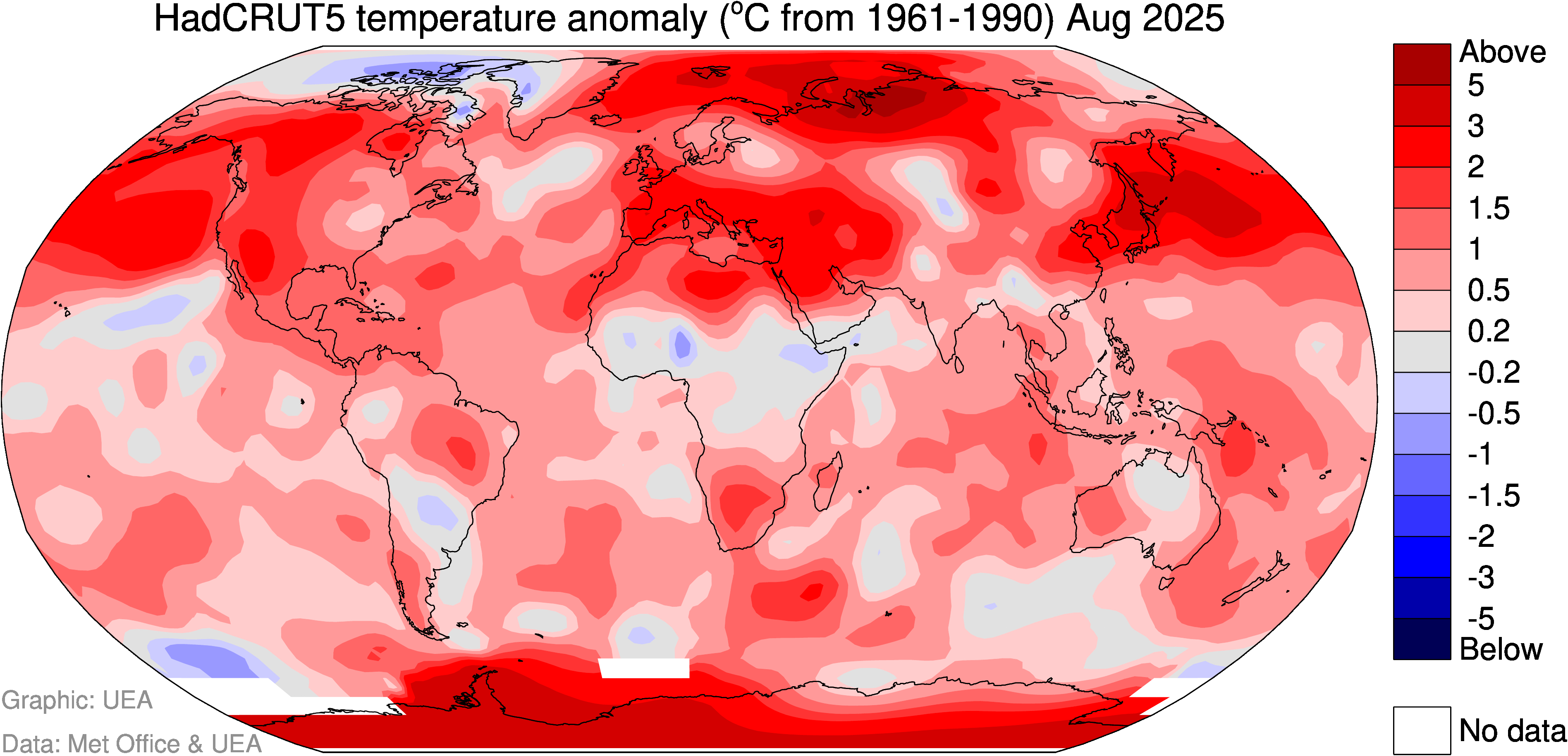
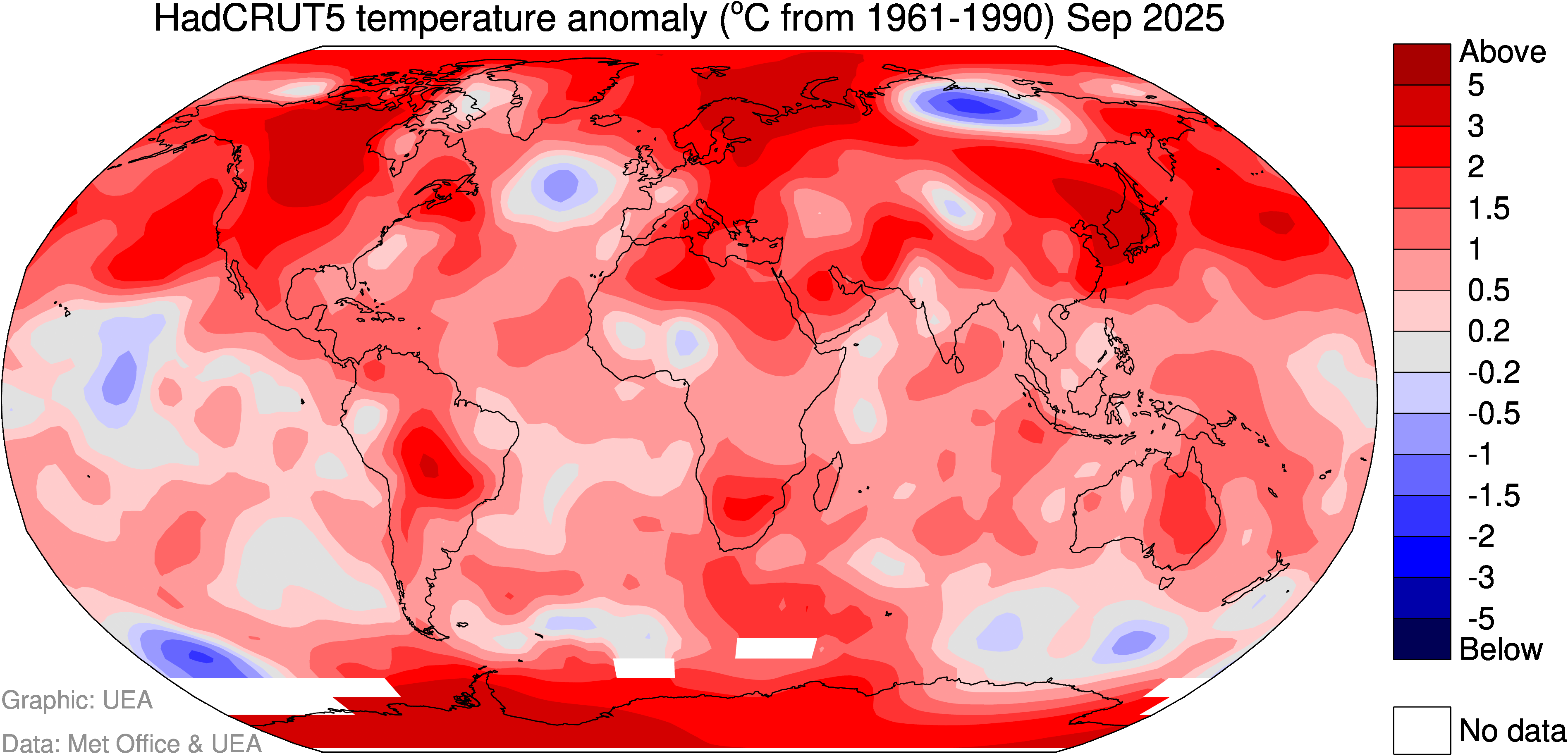
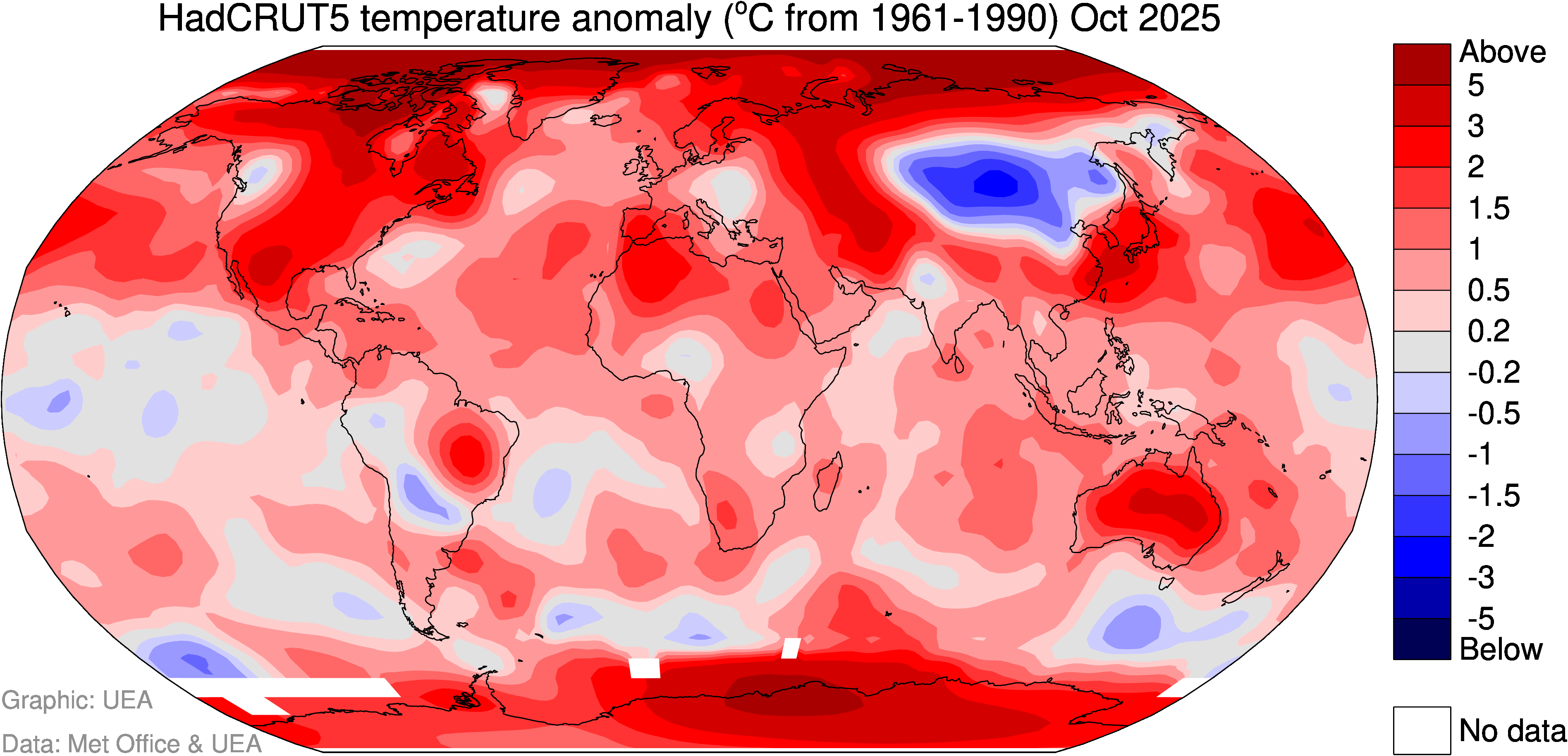
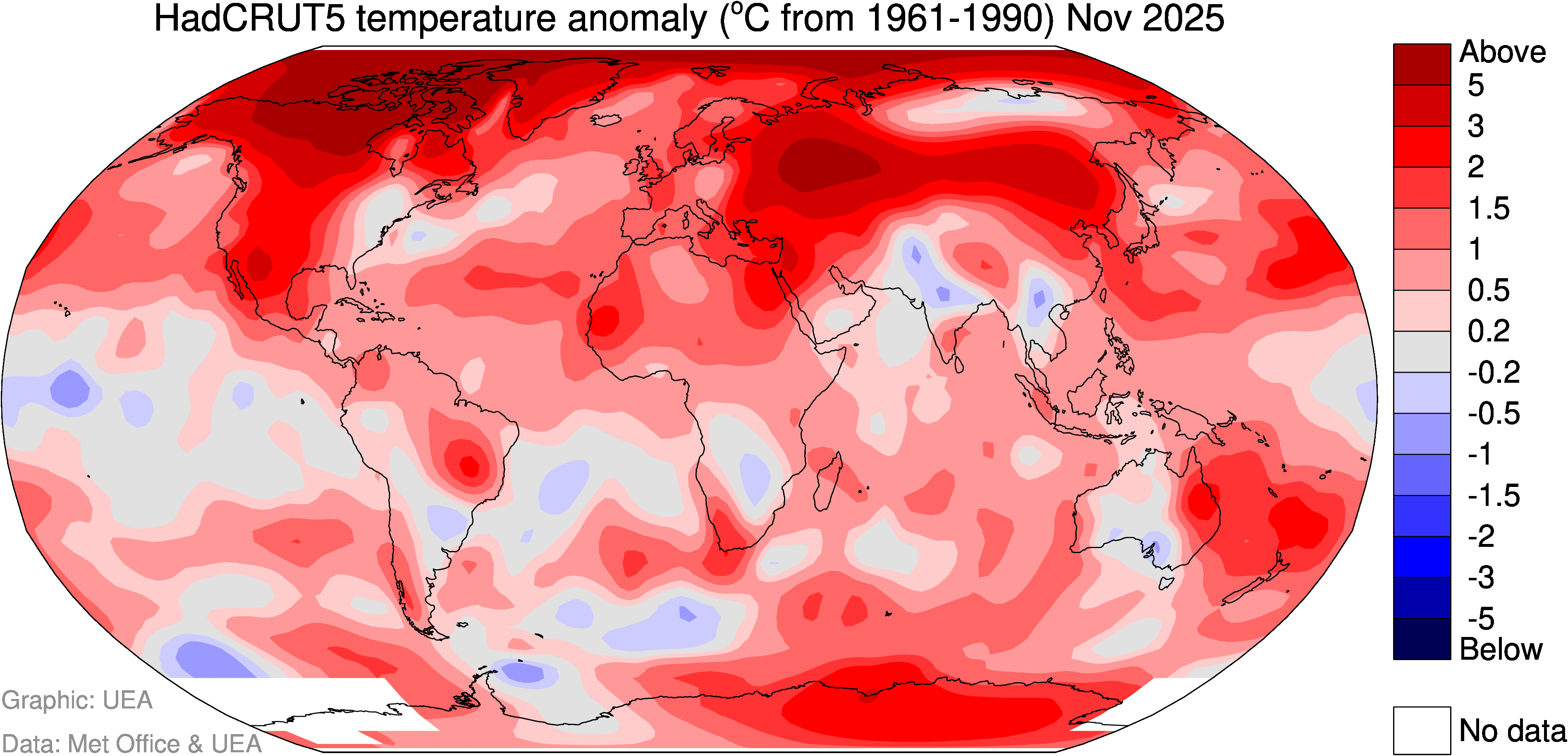
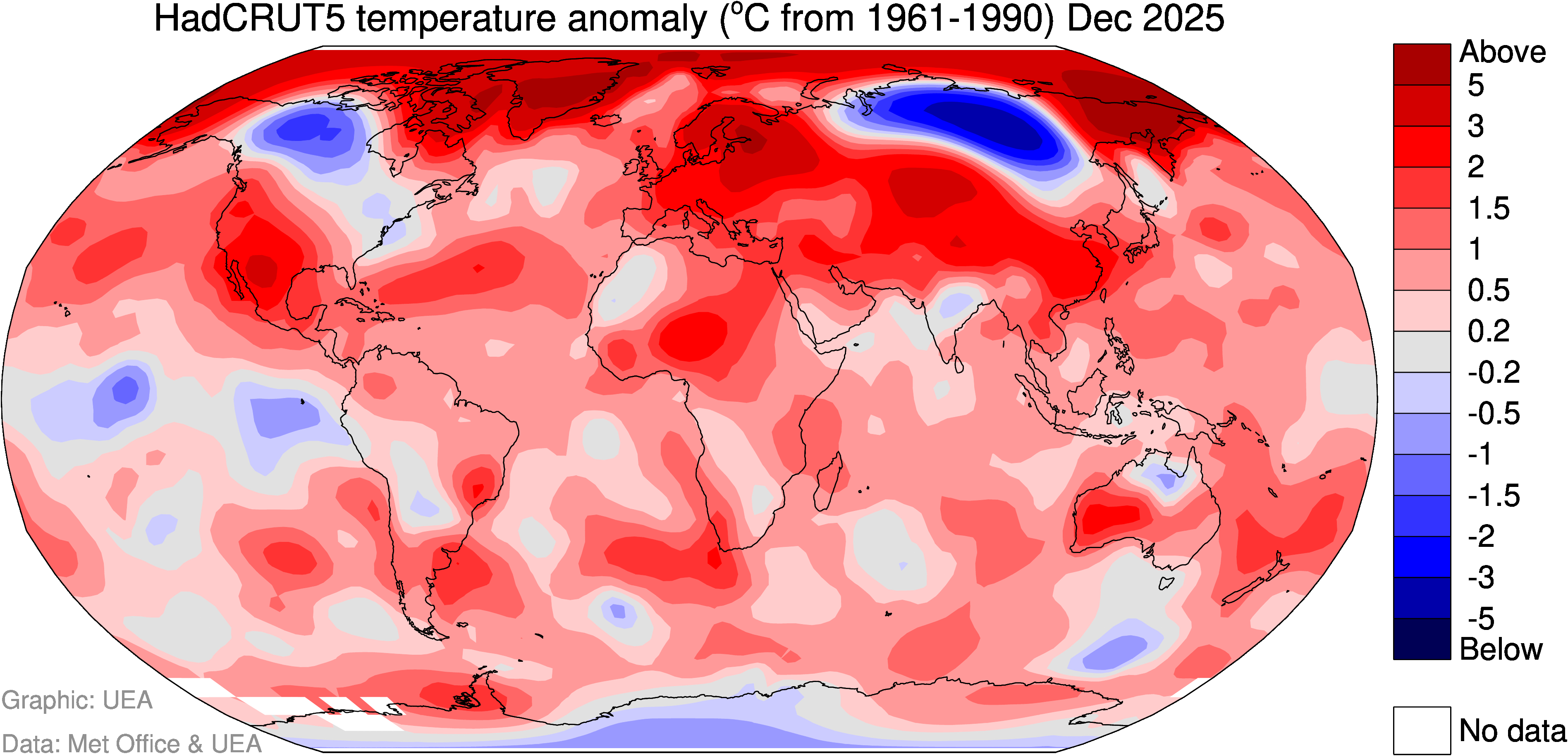
Where and when was it warmer or cooler than normal during 2025?


Refer to the annual, seasonal and monthly maps below of 2025 temperature anomalies
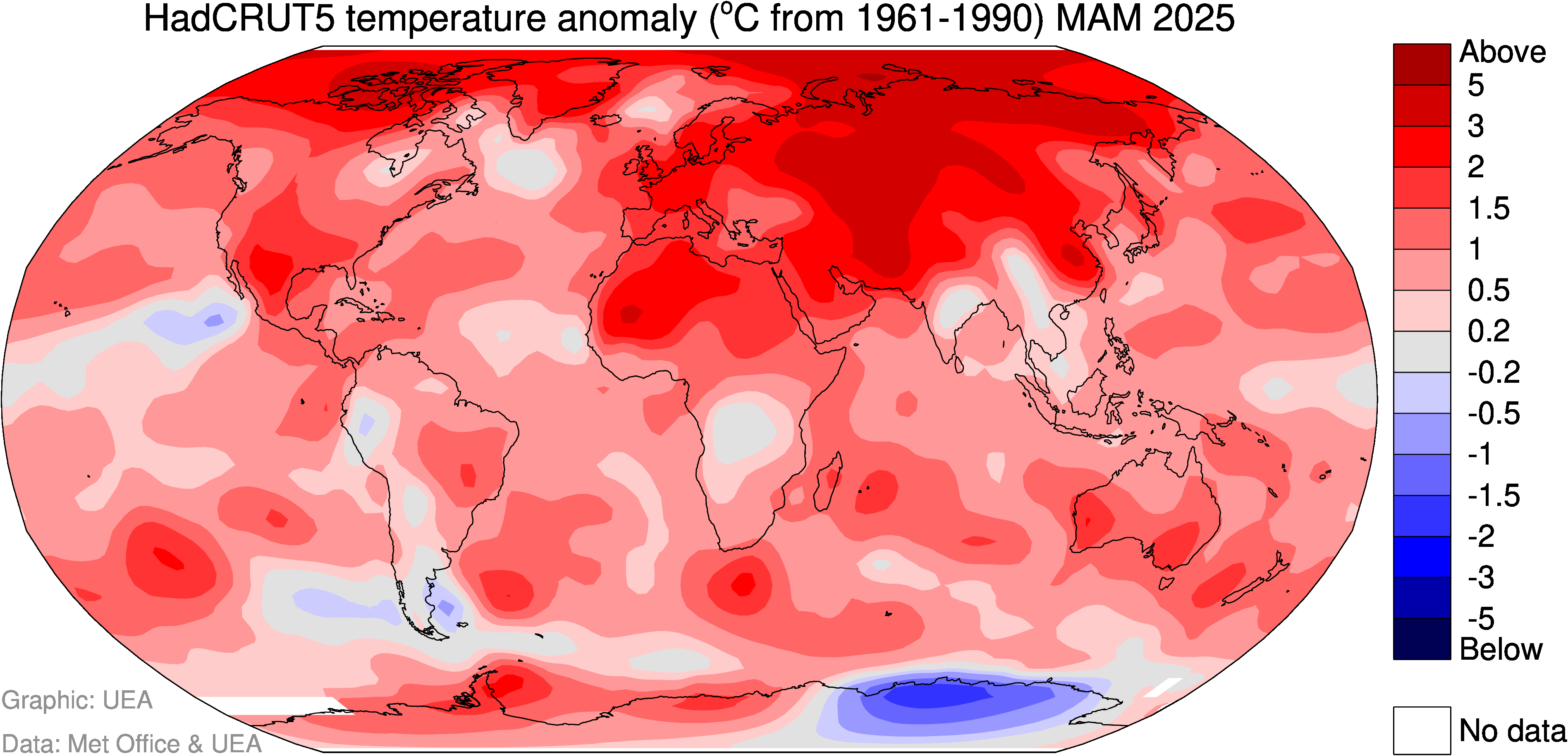
  • 2025 began with cooler anomalies across the equatorial Pacific (see the DJF map) from the continuing La Niña, while most other regions were warmer than the 1961-1990 baseline (+5°C in parts of Eurasia and North America)
  • The La Niña weakened during the course of the year, though tropical Pacific surface temperatures remained cooler throughout the year except in the west
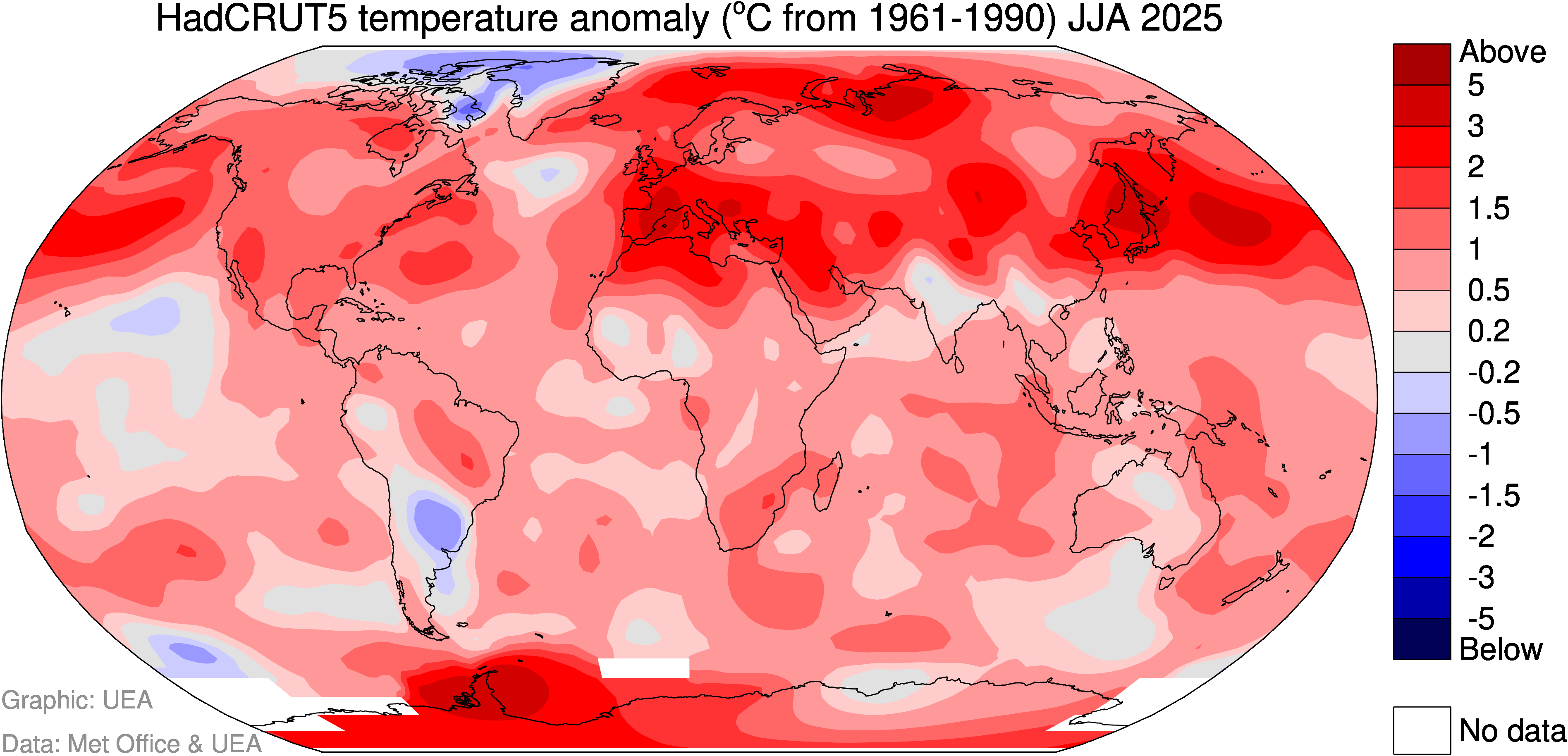
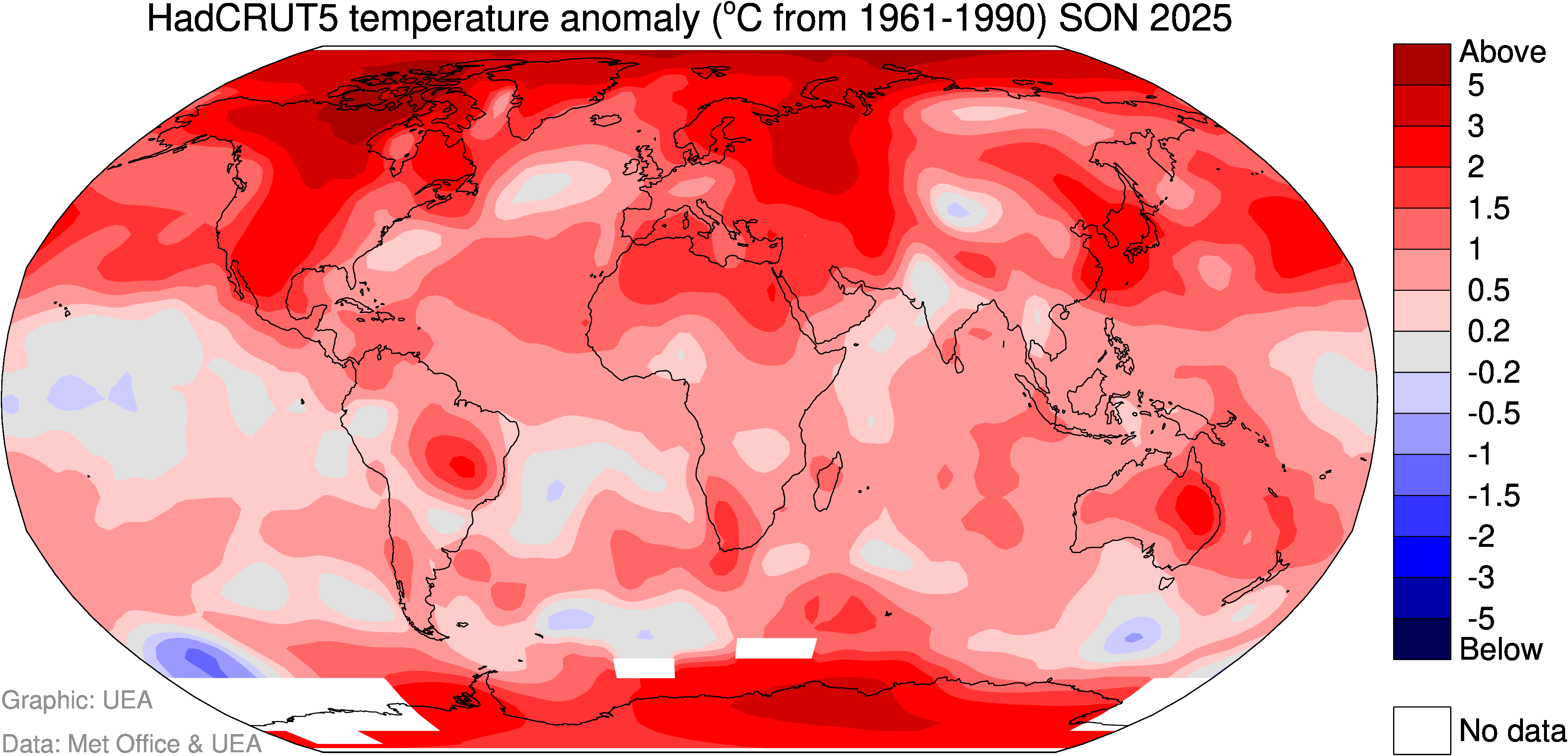
  • Antarctic temperatures were anomalously warm in the second half of 2025 (see the JJA and SON maps)
  • All continents showed some areas with temperature anomalies exceeding 2°C by the northern autumn (see SON map)
  • There were some strong dipoles (with notably low and high temperature anomalies in neigbouring regions) that were caused by persistent anomalies in mid-latitude atmospheric circulation, such as the blocking pattern that led to cooler than normal temperatures in Eastern Europe in May.


Temperature anomaly patterns for 2025 (click an image for a larger version)


Annual

Annual


Seasons

Winter DJF

Spring MAM

Summer JJA

Autumn SON


Months

January

February

March

April

May

June

July

August

September

October

November

December


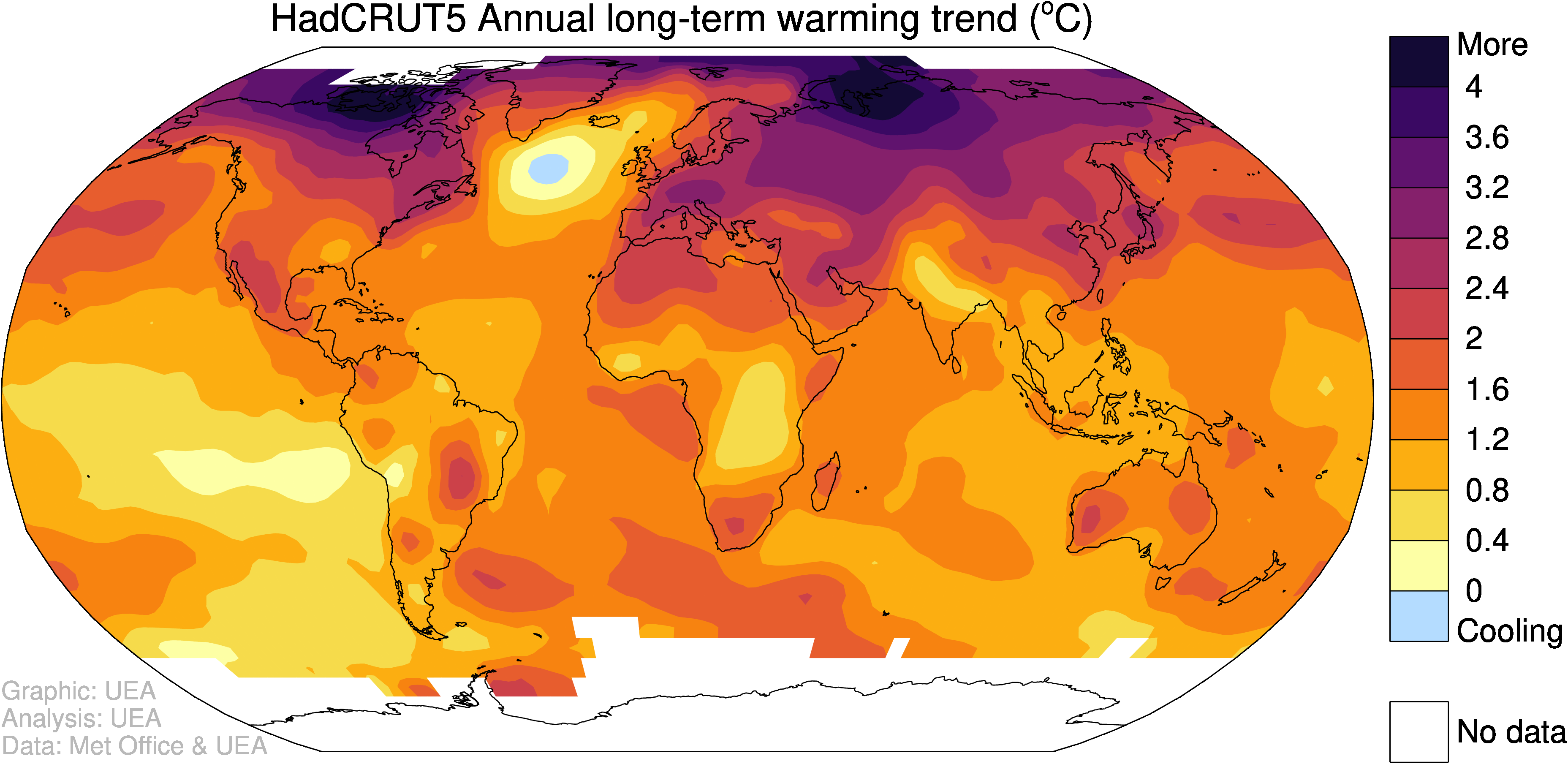
What is the pattern of warming from the early 20th century up to 2025?

  • Observed warming has not been uniform and matches well the pattern that climate models predict
  • Warming has been greatest over the northern polar regions
  • Warming is generally greater over land than over the oceans
  • There is slight long-term cooling in the North Atlantic Ocean, likely linked with changes in ocean circulation

Map shows the underlying temperature change (with short-lived variability smoothed out) in degrees Celsius from the 1880-1920 period up to the present-day.

Click image for a larger version
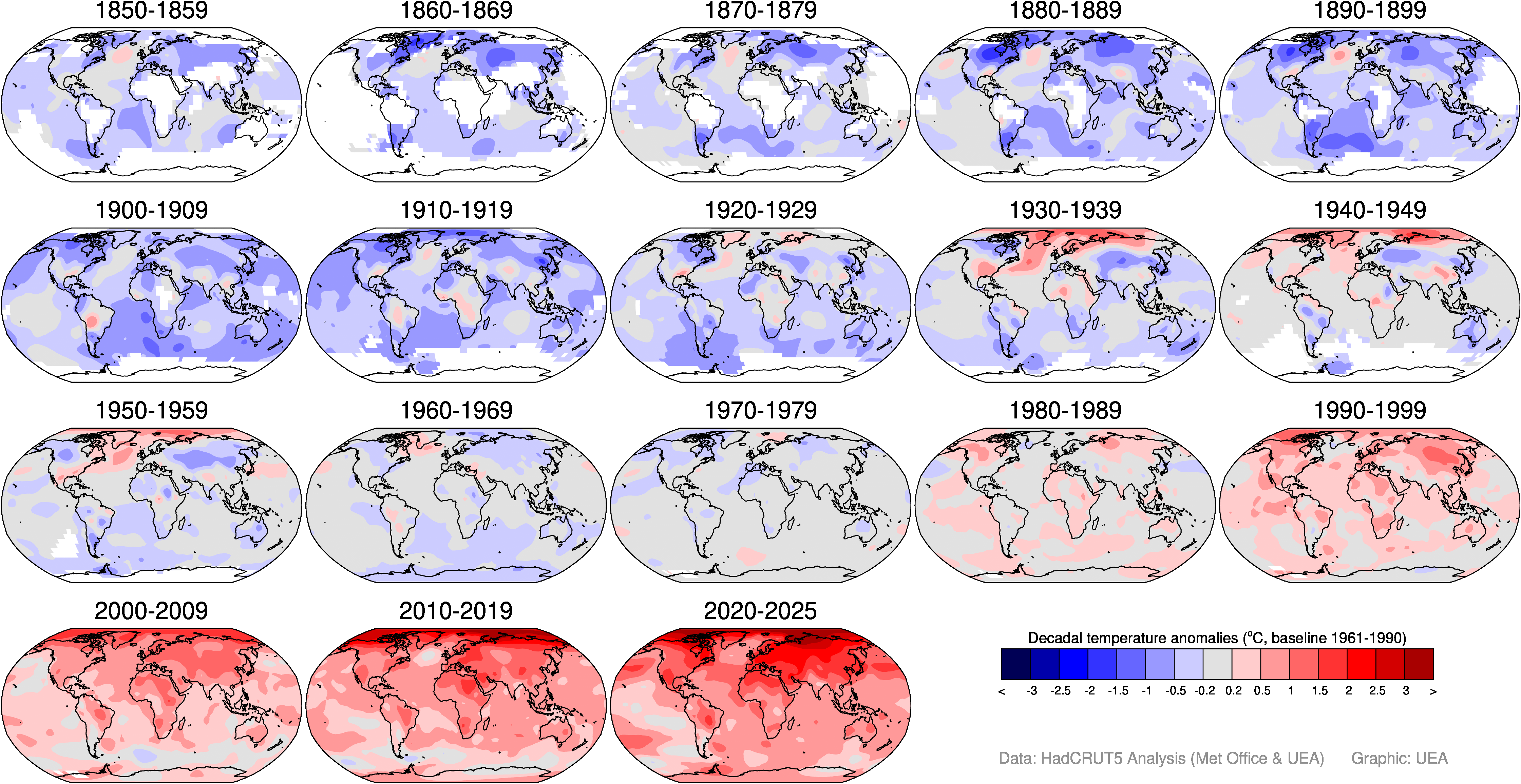


Temperature anomaly maps for every decade since the 1850s

  • Superimposed on the long-term warming pattern is considerable variability between decades
  • This is particularly noticeable over the ocean basins such as the Pacific and the North Atlantic
  • The early 20th century warming (compare maps from the 1910s to the 1940s) was confined mostly to the northern polar and Atlantic regions
  • In contrast, almost every location has warmed over the last 50 years

Click image for a larger version


2025 continues series of world’s three warmest years

A joint press release from the Met Office and the University of East Anglia (UEA).


The main reference for the HadCRUT5 dataset is:

Morice, C.P., Kennedy, J.J., Rayner, N.A., Winn, J.P., Hogan, E., Killick, R.E., Dunn, R.J.H., Osborn, T.J., Jones, P.D., and Simpson, I.R., 2021: An updated assessment of near-surface temperature change from 1850: the HadCRUT5 dataset. Journal of Geophysical Research 126, e2019JD032361 (https://doi.org/10.1029/2019JD032361).


We hope that these datasets and images/figures are used widely.

Graphs and maps. These images are made available under the Creative Commons Attribution 4.0 International License (CC-BY-4.0). You may freely share, copy, adapt and redistribute these images for both commercial and non-commercial purposes provided that you give credit to UEA. If the image already says it is from UEA, then just use it. If the image doesn't already credit UEA or if you adapt it so the UEA name is removed, then you should specifically credit UEA (e.g. "Used with permission from the University of East Anglia (UEA)").

Datasets. These datasets are made available under the Open Database License. Any rights in individual contents of the datasets are licensed under the Database Contents License under the conditions of Attribution and Share-Alike.

Please use the attribution Climatic Research Unit, University of East Anglia

Updated: Jan 2026